BEGINNER? - START HERE

Instructors

Our instructors have all trained in Aikido for many years and hold ranks ranging from rokudan (6th degree black belt) to nidan (2nd degree black belt). Many of them have trained in Japan with Morihiro Saito Sensei and his son, Hitohiro Saito Sensei.

Details about individual instructors can be found below.


Kim Peuser, Chief Instructor - Rokudan
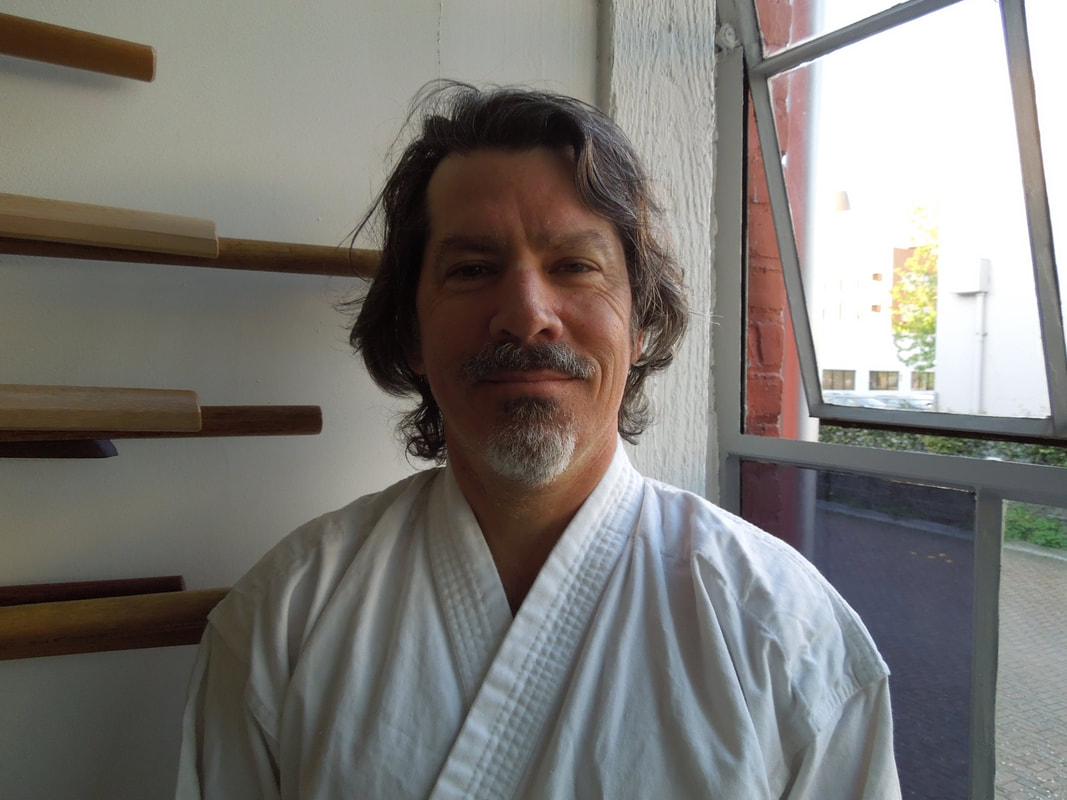
Kim Peuser, 6th Dan, Chief Instructor, began training in Aikido at the Aikido Institute Oakland in 1974. He was Chief Instructor at the dojo from 1988-1995 and again from 2002 to the present. He has trained extensively in California, and under Morihiro Saito Sensei, 9th Dan, of the Iwama Dojo in Japan. Peuser Sensei is the President of the Board of Directors of Aiki Integrated Arts and is a Director of the Takemusu Aikido Association.
Deborah Maizels - Godan

Deborah MaizelsI first started Aikido in 1973. An acting teacher suggested Aikido as a way to learn how to tumble. I had studied karate for about a year but wasn’t comfortable with sparring and wanted to find something that was powerful, but not aggressive. I was attracted to the Aikido perspective on power, strength, and competition. And I also wanted to learn how to roll gracefully.

I began my study of Aikido at the Aikido Institute with Alan Grow, the founder of the school. I continued my studies with Bruce Klickstein and Bill Witt Sensei. In 1980, I studied for a year with Morihiro Saito Sensei in Iwama, Japan. I returned to Iwama again in 1987 for a gasshuku.

I love training at our dojo because of the people who train here. Some of my strongest friendships have been forged at the dojo. O’Sensei once said that Aikido training should be ‘fun and serious’. Our dojo is committed to serious study as well as to some serious fun.

Alberta Hankenson - Yondan

Alberta HankensonI’ve been studying Aikido since 1975. The UC Extension catalog listed an Aikido class at $50.00 and a tai chi class at $65.00, and I had $50.00, so I signed up for the Aikido class.

When that class was over, several of us began looking for dojos, so we could continue, and one of us found the Aikido Institute, then on College Avenue, and gave a favorable report. So I ventured in, on a Sunday morning in October, 1975, and stayed ever since. And now I’m a yon-dan.

I went to study with Saito Sensei in Iwama, Japan, in 1982. Several people from our dojo, including Deborah Maizels, were already living and working there, which eased the way a bit. It was an educational and enjoyable experience.

There were several senseis at our dojo before I earned my sho-dan: Bruce Klickstein, the dojo-cho, needed to be in Japan for some time, so to fill in, we had Bill Witt, Hans Goto, Stan Pranin and Tom Everett. Latterly, my senseis have been Kim Peuser and Hoa Newens.

My working life as a public librarian gave me some mornings off, and after I’d been promoted to san-dan, I taught a morning class from 9:00—10:30 once a week. It was usually a small class—uchi deshi and a couple of others—and I was able to give much individual instruction. Then Hoa Sensei asked whether I could take over one of the alternate Saturday morning slots, which my work schedule permitted, so there I still am. With a larger class, I focus on appropriate levels of training for everyone, trying to make sure everyone “gets” it, and has fun at the same time.

I am still studying because I still have occasional break-throughs, and maybe I can get to the next level.

Our dojo is a special place. No one jeers at others’ mistakes. The expectation is that we all do our best, whatever it is, and we all try to help each other make it better.

Kathy Montgomery - Yondan

Kathy MontgomeryAlthough I had thought for years that I would like to study a martial art, I did not begin until I was 41 years old. A friend of mine spotted the Aikido Institute and we both started training in July 1987. I have been training here every since.

When I started training I never thought about becoming a black belt. I trained because it was fun and I found the movement enjoyable. I continue to train for the same reasons. Over time, training has lead to more advanced rank. I am now a yondan.

Aikido is challenging. There is always something more to learn, techniques to refine to make the movements more subtle, but more powerful, to neutralize one’s partner without force or strength and with minimum discomfort to one’s partner.

Stephen Kilmer - Yondan

Stephen KilmerI began studying Aikido at the Aikido Institute in 1981. I wanted to study a martial art, but wasn't leaning toward any particular one, so I read a lot about different martial arts. In his book, "Zen and the Martial Arts", Joe Hyams described some of the philosophy and techniques of Aikido and I was immediately attracted to both. I found the Aikido Institute in the phone book and observed a Saturday class. I signed up right away.

I have studied with Bruce Klickstein, Kim Peuser, and Hoa Newens. I have found that Aikido changes the more I study. I'm sure this is a reflection of how I have changed and of the increasingly more detailed things my teachers have shown me about Aikido the longer I've trained.

I began teaching Aikido in 1987 at Aikido of Benicia when Kayla Feder Sensei needed someone to cover some classes while she was in school.

When I teach Aikido, the focus of a class can be technical or conceptual, but in either case it depends on what the people in the class, including me, are interested in. If there is a technique or an aspect of Aikido, such as how to blend with a certain attack, that seems to be of interest, I'll focus on that. There have been times when I've had something particular in mind for a class, but because of the makeup of the class (maybe there are several new students who need to work on the basics) I've thrown out everything I planned to do and switched to something else. I found it important to observe the way the students respond to what you're teaching and adapt to it. In a way, this is exactly like doing Aikido. You can't do a technique based on a fixed notion you have of the situation, you have to do what is appropriate to the situation.

I love showing Aikido to someone who's seeing it for the first time. Doing demos or working with a student who is doing something for the first time or exploring some aspect of a technique are the times I enjoy the most.

I work as an IT Manager. After I started teaching I found that I became more comfortable making presentations at work. Aikido has also had an effect on other parts of my life. The awareness that one learns in Aikido extends to all aspects of one's life without our even thinking about it.

I continue to study Aikido because there's always something new to learn. Even doing the most basic blending practice is a new experience when I'm training with a new student or when sensei is evaluating my progress.

Sensei and all of the students and teachers are great people and fun to train with.

Cynthia Lorie - Sandan

Cynthia LorieI began studying Aikido at the Aikido Institute in 1991 and was promoted to Sandan in 2000. I first came to the dojo because I wanted to get off the couch and make some new friends. My interest in Aikido continues to grow - the best thing about Aikido is that there is always more to learn and experience.

When teaching class, I like to focus on the "building block" aspect of Aikido - starting with a simple blend and allowing it to grow and to become more fluid. From this base, I add on different techniques, starting with basic, static techniques and working up to more complicated and flowing movements.

I love the Oakland dojo because of the community and support. It is the one place where all outside distractions melt away and I can be completely focused on blending together body and spirit.

Leif Branson - Sandan

Leif BransonI began studying Aikido at the Aikido Institute in August, 1993. I was attracted to Aikido because I wrestled in highschool. Also, watching people take falls reminded me of bodysurfing in Hawaii.

I have studied in Iwama on two occasions as uchi deshi (in-house student) under both Morihiro Saito Sensei and his son, Hitohiro Saito Sensei. I have also studied as an uchi deshi at the Aikido Institute.

I teach second grade in the Oakland public school system and was the children's program instructor at the Aikido Institute for six years.

I continue my study of Aikido because of the community aspect of the dojo. Also, I want to continue the art for future generations. I love this dojo because Saito sensei said, "oakurando dojo wa ichiban desu." and I believe it.

Richard Levitt - Sandan

Richard LevittI began a serious martial arts practice in the early 80s, studying Tai Chi with Terry Dunn in Hollywood . He taught at a Taoist school, which also had classes in the Shaolin 5 Animals, and Long Fist, so I was exposed to a culture rich in heritage and depth. I practiced the Yang Long and Short Forms, for about five years in L.A. and S.F. Then I wanted something more martial and direct, and began practicing Wing Chung Kung Fu with Eddie Chong . Wing Chung is an extremely linear, focused attacking form, all arms and fists. This was the foundation of Bruce Lee’s martial arts, and the root of Jeet Kune Do, his own form. After about five years, I took a short break, then began to train in Tae Kwon Do, a fighting art. I liked the practicality and immediacy of it, but didn’t like getting beaten up all the time. That only lasted about two years. I took another short break, then began my Aikido practice at Aikido Institute in about 1991.

I liked Aikido because it focuses on taking an “inside” position, and I’ve always believed it’s better to be close to an opponent than far away. Also, the system of joint locks, throws and pins was a complement to my previous training. But the real attraction was the joyful intensity I saw on the mat; people piling in with vigorous attacks, and getting thrown all around, then smiling with friendship and appreciation.

Now, after nearly 15 years of practice, including about five weeks with Saito Sensei at the Iwama dojo in Japan, Aikido is an integral part of my life. The lessons of Aikido — of blending, clarity, compassion, fluidity and improvisation — inform my business, my marriage, my relationships with family and friends. I’m constantly challenged to improve my technique, my presence on the mat, my awareness. Teaching brings all that into focus, since I have to be able to articulate and demonstrate my ideas and experience, to share it with others.

Josh Langenthal - Nidan

Josh LangenthalI began Aikido training at the Aikido Institute in the summer of 1993 and have been a regular member ever since. I have studied principally with Kim Peuser and Hoa Newens Senseis at the Aikido Institute and also with various teachers from the Morihiro Saito lineage, including Saito Sensei on his trips to the United States. I achieved Nidan in 2005 and teach on a substitute basis.

I began studying Aikido for two primary reasons. One, as a Type I Diabetic, I wanted to create a life-long physical fitness regime. Two, I wanted to have a personal practice through which I could grow and improve myself. Aikido practice has provided me this and more, as I have gotten older. It has helped me in my personal relationships, as well as in my work place experiences and when I have changed careers. It is especially helpful for me as a husband and parent and in my part-time work as a pre-school teacher.

I experience Aikido class as active meditation – a time when my mind clears as my body is learning how to do new things. I experience “flow”moments and, as a teacher and partner, I try to provide the opportunity for this experience with my partners. I fell in love with the Oakland dojo from the first class for so many reasons, but especially for the fierce kindness and great teaching of the senior students and teachers.

Now, as a senior student and occasional teacher, I try to give back in the same way.

Martha Evans-Holm - Nidan

Martha Evans-HolmI started my Aikido career in September of 1989 at East Bay Aikido. I had practiced Martial Arts before (Tae Kwon Do) in college and was looking to get back into something physical and martial when we came across a dojo that was in our neighborhood. My husband (Lars Eric Holm) had done a similar art (Hapkido) in Alaska when he was a teenager. We both decided to give it a try.

I received the rank of Nidan in April of 2003 at Aikido Institute of Oakland and continue to study because it's a great way to keep my body in shape and meet great people (training partners). I love the close, community atmosphere. Also it gives me quality time with my youngest, who also trains.

I started teaching in children’s classes in 1997 at East Bay Aikido. In 2005, I and Lars Eric Holm (Head Instructor for the children’s class) began leading the children’s program at the Aikido Institute.

I have studied with Tom Gambell Sensei and Kim Peuser Sensei.

I love the people who train at the Aikido Institute. There are a lot of high-ranking Aikidoists who have trained in Japan and around the world with a wealth of knowledge to draw from.

Lars-Eric Holm - Nidan
Lars Eric HolmContent 11